vo2max.jp is live. ESPL is adding HIIT, with VO2max as the goal
We have launched vo2max.jp, a Japanese-language site for understanding, measuring and improving VO2max (maximal oxygen uptake). ESPL also plans to add high-intensity interval training (HIIT). Research shows HIIT raises VO2max, but it is hard to keep up. We want to make it sustainable with ESPL's support-money mechanism, and help users raise their VO2max.

Try ESPL
Today we launched vo2max.jp, an information site about VO2max (maximal oxygen uptake). It is run by Sense It Smart Corporation, the company behind ESPL. The site is in Japanese.
We are also sharing where ESPL is heading. ESPL plans to add high-intensity interval training (HIIT), with one goal: helping users raise their VO2max.
What VO2max measures
VO2max is the body’s capacity to take in oxygen, carry it in the blood and use it in the muscles. It is the standard measure of cardiorespiratory fitness, expressed as millilitres of oxygen per kilogram of body weight per minute (mL/kg/min). Smartwatches such as the Apple Watch now display an estimate, so many people see the number without knowing what it means.
Japan’s Ministry of Health, Labour and Welfare (MHLW) describes cardiorespiratory fitness in its Physical Activity and Exercise Guide 2023 as a strong predictor of death and disease from many causes. The guide summarizes research in which each additional 1 MET (3.5 mL/kg/min) of fitness was associated with a roughly 10 to 20% lower relative risk of all-cause and cardiovascular death.
These are associations from large cohort studies. They do not predict or guarantee any individual outcome. Even so, the same guide says that people at every fitness level can expect substantial health benefits from raising their fitness, even slightly.
What vo2max.jp does
vo2max.jp walks readers through four steps: understand, measure, improve, sustain.
- Understand: the age and sex reference values published by MHLW (reference table).
- Measure: compare a smartwatch reading, or an estimate from resting heart rate, with those values (comparison tool). Inputs are calculated on the device and are never sent or stored.
- Improve: start with moderate-intensity continuous exercise, following MHLW’s guidance on duration, frequency and intensity (moderate exercise).
- Sustain: an 8-week plan is in preparation.
The site is run as a neutral information resource. Every figure is sourced, methods are presented by strength of evidence, and whenever ESPL is mentioned it is labelled as the operator’s own app.
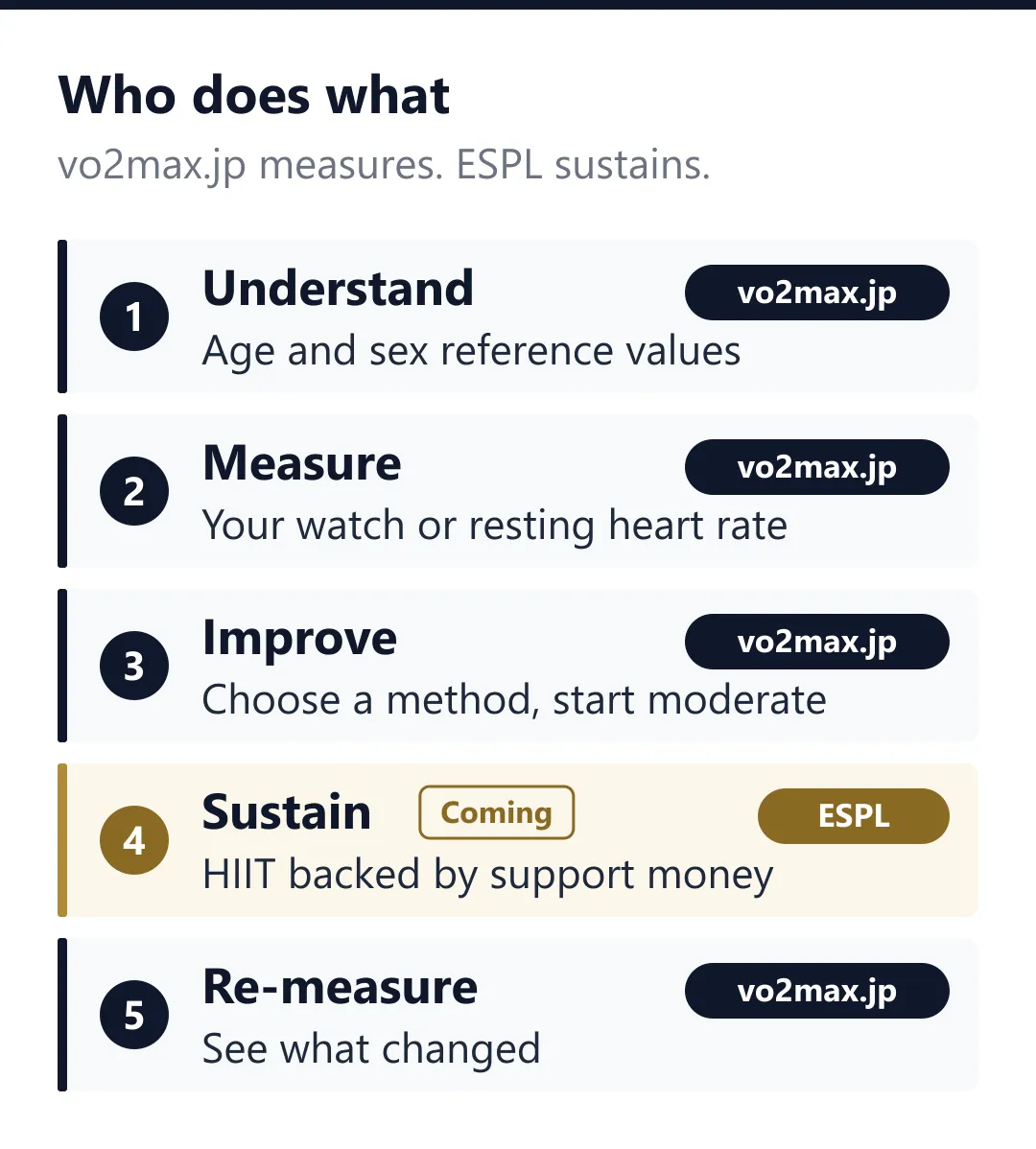
The site measures, the app sustains. How vo2max.jp and ESPL divide the work
Why HIIT
HIIT alternates short bouts of hard exercise with rest or light exercise. It is one of the most studied ways to raise VO2max.
A meta-analysis of 28 controlled trials in 723 healthy adults aged 18 to 45 found that, compared with no-exercise controls, VO2max rose by an average of 5.5 mL/kg/min with HIIT and 4.9 mL/kg/min with continuous endurance training. Compared head to head, HIIT came out ahead by 1.2 mL/kg/min, a small difference (Milanović et al., 2015).
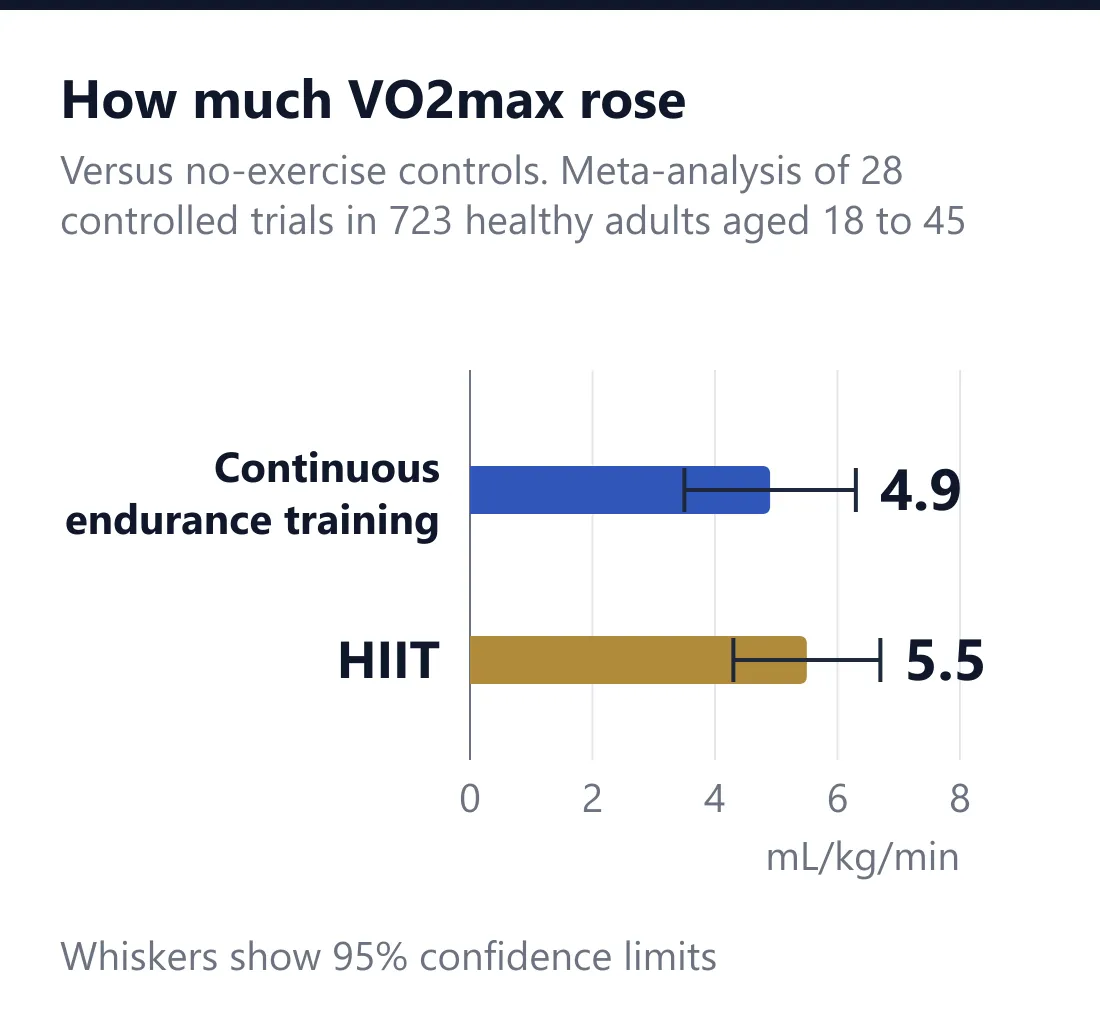
Both forms of training raised VO2max, and HIIT did slightly better. Source: Milanović et al., 2015, Sports Medicine
In a Norwegian study, 40 healthy, moderately trained men were randomized to four groups and trained three times a week for eight weeks. The group running 4 × 4 minutes at 90 to 95% of maximal heart rate, with 3 minutes of easy running between bouts, raised VO2max from 55.5 to 60.4 mL/kg/min, a 7.2% gain. That was significantly more than the lower-intensity groups doing the same total work (Helgerud et al., 2007).
In people with lifestyle-related cardiometabolic disease, such as coronary artery disease, hypertension or obesity, a meta-analysis of 10 studies (273 patients) found that HIIT raised peak oxygen uptake by 3.03 mL/kg/min more than moderate continuous training (Weston et al., 2014).
Individual responses vary in every study. Average results are not a promise about any one person.
Effective, but hard to sustain
HIIT has one more defining trait: it is hard.
A proven method does nothing for VO2max if people stop doing it, and the harder the exercise, the harder it is to keep going.
ESPL is built around mechanisms that keep people walking. When users create a challenge, they put support money in up front, a commitment device in behavioral-economics terms. If the goal is missed, the money they or someone they care about would have received does not arrive. Loss aversion and altruism, the wish to do it for someone else, become reasons to continue.
JPYC, a yen-denominated stablecoin, is the infrastructure underneath: it holds the support money in yen terms and distributes it exactly as promised. For details, see Using loss aversion to support a walking habit.
We think HIIT, precisely because it is hard to sustain, is where this mechanism can do the most good.
HIIT is coming to ESPL
ESPL plans to add HIIT in a future update. As with walking challenges, users will be able to back their HIIT sessions with support money. We will announce timing and details in the app and on this site once they are settled.
The goal is to help users raise their VO2max.
To be clear, we do not yet have measured data showing that using ESPL raises VO2max. That is exactly why we built vo2max.jp as a place to measure. Check your value before you start, re-check after, say, eight weeks, and you can see the change for yourself. Use your smartwatch or the estimation tool on vo2max.jp to get the number.
Before you start
HIIT is vigorous exercise. Based on MHLW’s guidance:
- If you have a medical condition or take medication, talk to a doctor first.
- If you do not exercise regularly, do not start with HIIT. Build up gradually from light or moderate activity.
- Stop immediately if you feel chest pain, palpitations, dizziness or light-headedness, cold sweats, or unusual fatigue.
- If you take medication that affects heart rate, such as beta blockers, heart rate is not a reliable guide to intensity. Go by perceived effort and confirm the right intensity with your doctor.
Summary
- We launched vo2max.jp, a Japanese-language site for understanding, measuring and improving VO2max.
- Research shows HIIT raises VO2max. Continuous exercise does too, and HIIT does slightly better.
- ESPL plans to add HIIT, backed by its support-money mechanism, with the goal of raising users’ VO2max.
- vo2max.jp measures; ESPL sustains. Measure before and after to see what changes.
This article provides general health information, not individual medical advice. If you have a medical condition or any concerns about exercise, consult a doctor before starting.
Start by knowing your VO2max
References
- Ministry of Health, Labour and Welfare (Japan). Physical Activity and Exercise Guide for Health Promotion 2023, INFORMATION 6: Cardiorespiratory fitness (peak oxygen uptake). (PDF, Japanese)
- Ministry of Health, Labour and Welfare (Japan). Physical Activity and Exercise Guide for Health Promotion 2023, INFORMATION 4: Points for safe physical activity and exercise. (PDF, Japanese)
- Milanović Z, Sporiš G, Weston M. “Effectiveness of High-Intensity Interval Training (HIT) and Continuous Endurance Training for VO2max Improvements: A Systematic Review and Meta-Analysis of Controlled Trials.” Sports Medicine. 2015;45(10):1469–1481. doi:10.1007/s40279-015-0365-0
- Helgerud J, Høydal K, Wang E, et al. “Aerobic high-intensity intervals improve VO2max more than moderate training.” Medicine & Science in Sports & Exercise. 2007;39(4):665–671. doi:10.1249/mss.0b013e3180304570
- Weston KS, Wisløff U, Coombes JS. “High-intensity interval training in patients with lifestyle-induced cardiometabolic disease: a systematic review and meta-analysis.” British Journal of Sports Medicine. 2014;48(16):1227–1234. doi:10.1136/bjsports-2013-092576
Share