Help / wallet
Networks and wallets
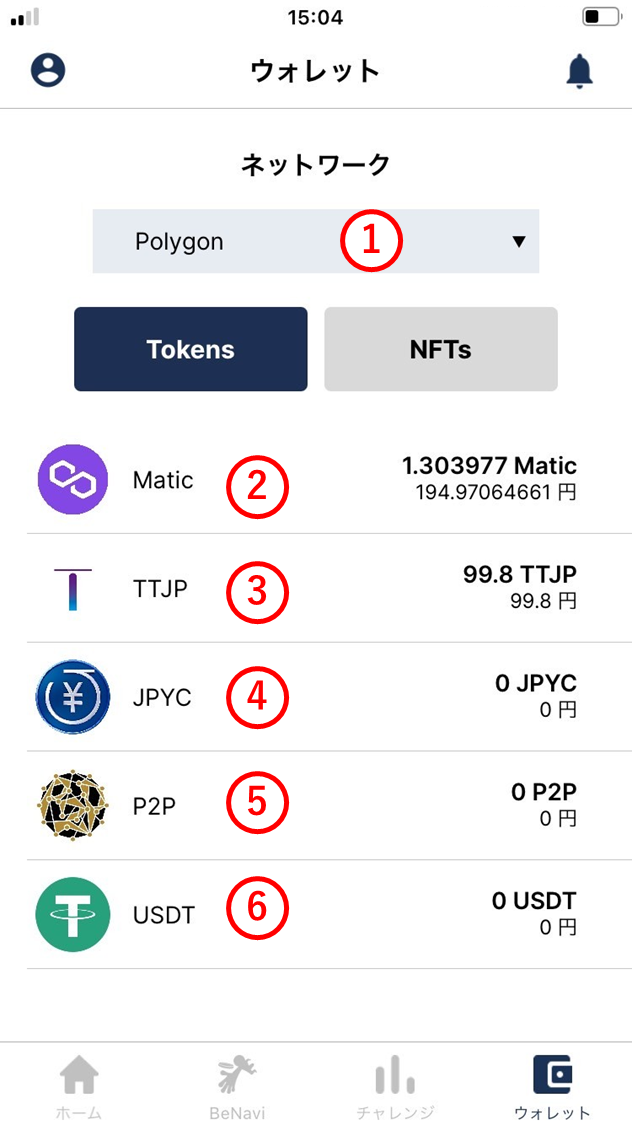
Shows the blockchain network (Polygon, Mumbai) used by ESPL to send and receive crypto-assets and tokens.
-
Shows the blockchain network (Polygon, Mumbai) used by ESPL to send and receive crypto-assets and tokens.
-
Below the network, the balances of the crypto-assets and tokens used by ESPL are shown.
(1) Network
-
The blockchain network (Polygon, Mumbai) used by ESPL to send and receive crypto-assets and tokens.
-
You usually don’t need to change this.
- Polygon
-
Polygon is an open-source distributed-computing platform that implements decentralized applications (dApps) via smart contracts. The crypto-asset used on Polygon is POL (formerly MATIC).
-
In ESPL, you can create challenges using POL and the ERC-20 tokens TTJP and JPYC.
-
In Japan, POL can be purchased with Japanese yen (JPY) at several crypto-asset exchanges, including bitFlyer and bitbank. Check each exchange for current availability.
-
You can also purchase it in MetaMask using a credit card or Apple ID.
-
- Polygon
(2) POL
POL is Polygon’s native crypto-asset, used for fees and staking.
(3) TTJP
The original ESPL token.
(4) JPYC
A prepaid stablecoin issued on public blockchains. It’s issued on Ethereum, Polygon, Gnosis, Shiden, Avalanche, and Astar, and can be used at 1 JPYC = ¥1 in JPYC Apps. Because JPYC is an ERC-20 token, you need to manage it yourself in a wallet such as MetaMask.
(5) P2P
CryptoBar P2P issues its own P2P Token. The P2P Token works at 1 P2P = ¥1 in participating stores.
(6) USDT
Tether is the first stablecoin in the world, created in 2014 by Bitcoin investor Brock Pierce, entrepreneur Reeve Collins, and software developer Craig Sellers. A stablecoin is a currency whose value tracks a fiat currency such as JPY or USD or a crypto-asset; Tether tracks the US dollar.
-